

Lead: Faced with galloping deforestation and the increasingly visible effects of climate change, trees appear as a natural yet still underutilized solution. On the occasion of the 42nd edition of Tree Day, we met with Djalal A., Country Director of CIFOR-ICRAF Benin. He explains how science and agroforestry can reverse the trend.
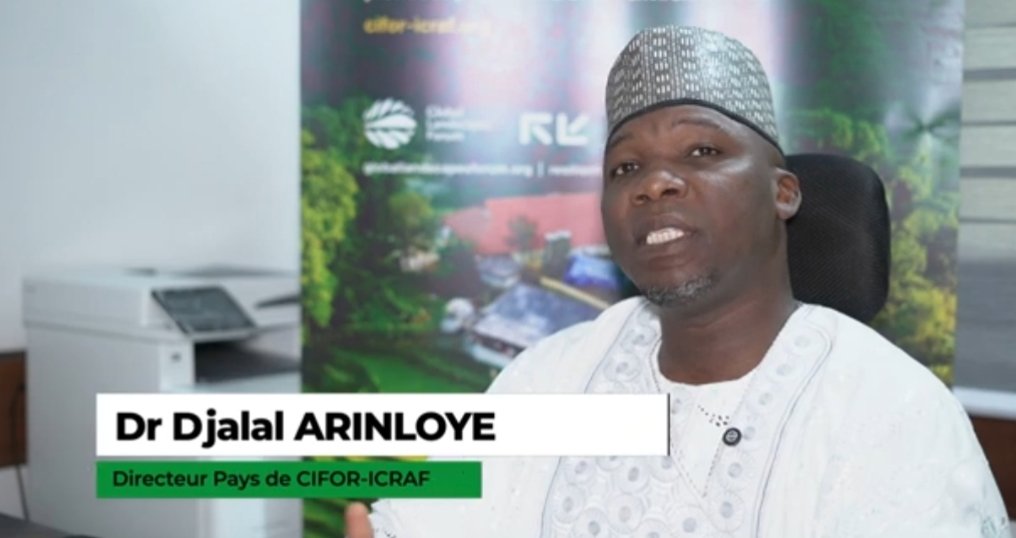
« The tree is a being to be produced, conserved, and monitored, » asserts Djalal A., Country Director of CIFOR-ICRAF in Benin. The organization he leads, born in 2019 from the merger of the International Center for Forestry Research and the World Agroforestry Centre, relies on scientific innovation to reconcile the environment with local populations. Its mission: « to use science and agricultural innovation to improve environmental and forest management, especially trees in the landscape, with the aim of improving living conditions and promoting population resilience against the effects of climate change. »
But concretely, what can trees do in the face of advancing desertification and the whims of the weather? Some answers.
The assessment drawn up by CIFOR-ICRAF is unequivocal. Asked about desertification in Benin, Djalal A. provides worrying figures: « Data from Global Forest Watch indicate that in 2020, forest cover in Benin stood at nearly 32 million hectares. That cover was reduced by 2025 to approximately 31,000 hectares. » A net loss of nearly one million hectares in five years, due mainly to « the expansion of agricultural land » and the migration of populations « toward areas that are relatively more forested. »
If nothing is done, the director warns, « in the long run, we risk feeling the effects of climate change even more severely. » The urgency, therefore, is to green the « hot spots » the areas most affected by degradation.
For CIFOR-ICRAF, the tree is not merely decorative. In urban settings, it plays a vital social and health role. Djalal A. explains: « Leaves have the ability to capture CO₂ and release oxygen. In cities, the greenest places are those that attract the most people when temperatures are extreme. The tree serves as a refuge for the population. »
In rural areas, its benefits are equally crucial. « When leaves fall to the ground, they enable better fertilization, replacing chemical fertilizers. The tree improves soil texture, aeration, and therefore productivity, » he details. As for rainfall, wooded areas benefit from « relatively more stable » precipitation.
Six strategic axes for sustainable action
CIFOR-ICRAF does not merely plant trees. The organization deploys six complementary areas of intervention in Benin: nature-based solutions for climate adaptation; biodiversity conservation and restoration; improvement of food security through forest products (baobab, moringa, etc.); promotion of sustainable enterprises and public-private partnerships; equity and governance around land resources and carbon credits; and soil health restoration a major undertaking in Benin using satellite and physical mapping to guide local decisions.
This year, for the 42nd edition, CIFOR-ICRAF is placing emphasis on youth. « We are working in collaboration with the forestry inspectorate of Atlantique and Littoral to raise awareness among young learners about the importance of trees, » stresses Djalal A. The objective is to disseminate « the technologies we have developed, the most suitable areas, and how trees can contribute to nutrition, shade, and carbon sequestration. »
Tangible results already visible
Since 2017, CIFOR-ICRAF has trained farmer groups in climate-smart agroforestry techniques. And the results are tangible. « Farmers who have adopted these technologies generate double the income compared to those who have not adopted them, » the Country Director notes with satisfaction. The benefits are observed both for cereal crops and for associated tree products.
By way of a plea, Djalal A. issues a solemn call to his fellow citizens: « Today, we cannot flee our environment. You can flee your home to go elsewhere, but you cannot flee nature. The actions we are taking to promote trees are actions that could cost us our lives if we fail to carry them out. »
He concludes by recalling the spiritual and ecological dimension of trees: « Whether in Christianity, Islam, Buddhism, or traditional religions, the tree is a source of tradition and faith. Plant a tree: it will attract bees, birds, and help conserve endangered species. »
For CIFOR-ICRAF, planting a tree today means investing in the survival of Benin tomorrow.
Interview conducted by Daré-Montan Dossoumou and processed by Megan Valère Sossou