

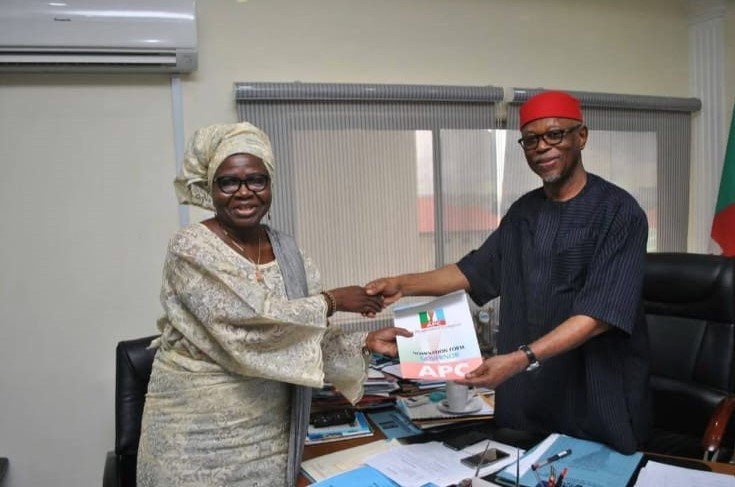
It was a humid afternoon in Akure, the capital of Ondo State, when 42-year-old Funmilayo Waheed-Adekojo, a native of Arigidi-Akoko, walked smartly into the state secretariat of the All Progressives Congress (APC). Clutching her expression of interest form, she exuded confidence that belied the odds stacked against her. Around her, male party loyalists whispered, some sneered, others laughed. She was the first aspirant to pay for and pick up the form to contest the 2024 Ondo State governorship election.
(Image UNDP website)
OLUFISOYE ADENITAN
A Mechanical Engineer by training and a Chartered Management Consultant by profession, Waheed-Adekojo had returned home from Abuja with bold intentions. She wanted to break the glass ceiling in a political landscape where women were treated not as contenders, but as symbolic placeholders.
“I knew what I was up against,” she said later in an interview. “When women come out to contest elections, the predominance of men in power is not surprising. What is surprising is that many times, it is women themselves who reinforce the stereotypes by not supporting one another.” Waheed-Adekojo stated.
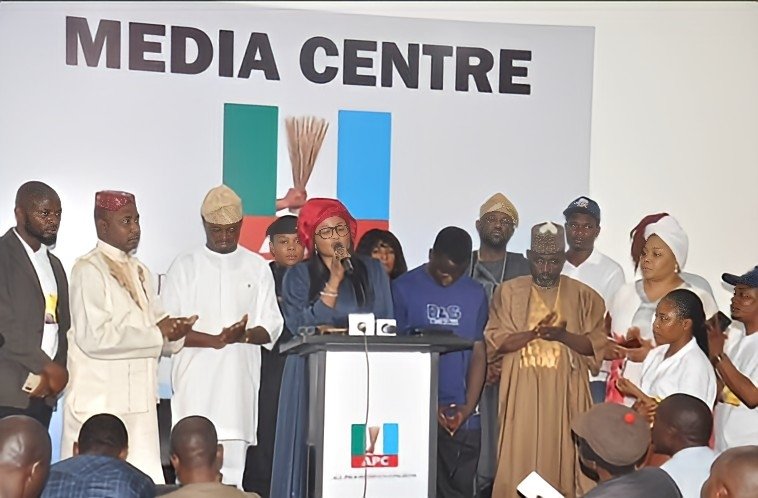
Her courage was tested almost immediately. The APC guidelines asked female aspirants to pay ₦10 million for the expression of interest form. They were exempted from the ₦40 million nomination fee, a “concession” that critics described as tokenism rather than genuine inclusion. Other major parties, including the PDP and Labour Party, adopted similar practices. By November 2024, the party primaries had ended, and 17 men emerged as candidates. Not a single woman made it to the ballot. Funmilayo Waheed-Adekojo’s story is not an isolated one. Data reveals the gaps in women political leadership in Ondo and Osun States, with women having similar experiences that reinforce stereotypes, patriarchy, and chauvinism.
According to data from the Independent National Electoral Commission (INEC), the registered voters in Ondo State for the 2024 governorship election were 1,991,344, with a near-equal gender distribution of 50.52 percent male and 49.48 percent female voters. Similarly, the same data was also used for the local government election in February 2025. Data from Osun State reveals a similar trend. Numbers from INEC reveal that the 2022 governorship election shows that out of 1,954,800 registered voters, 47.24 percent were male, while 52.76 percent were female. Despite the close numbers of eligible male and female voters, all 15 political parties in Osun fielded male gubernatorial candidates, while only six female candidates ran for deputy gubernatorial positions.
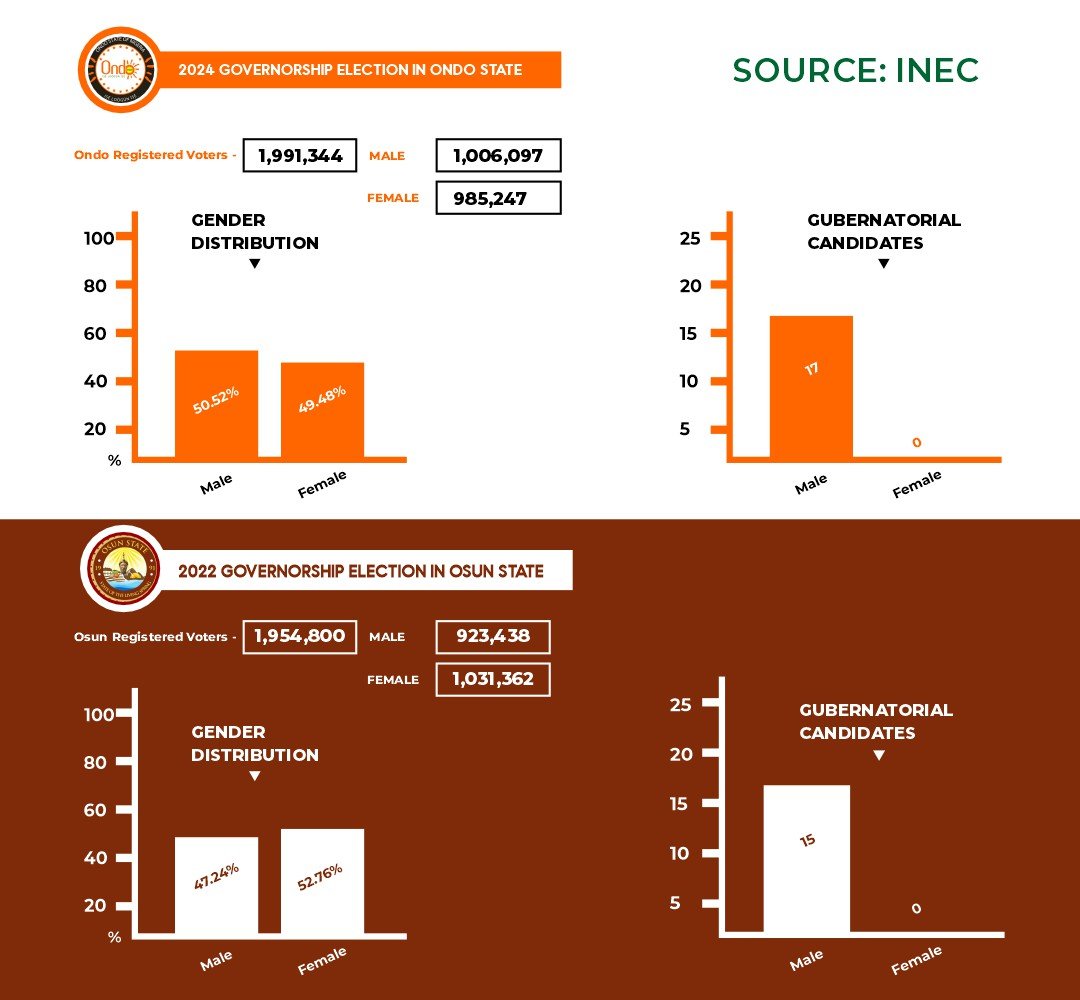
Analysis of Ondo and Osun States Governorship Election.
Across Ondo and Osun States, and indeed the country, the political playing field remains skewed. Despite near-equal numbers of male and female voters, women continue to face systemic exclusion in both elective and appointive positions. This investigation delves deeply into the journeys of female trailblazers in Ondo and Osun States, uncovering the obstacles they face, the systemic biases entrenched in party politics, and the cultural and economic barriers that perpetuate a perception of Nigeria’s democracy as a men’s club.
The Numbers Don’t Lie
Democracy thrives on participation, yet the statistics from Nigeria tell a different story. The picture changed dramatically when it came to candidates on the ballot. In Ondo, all 17 governorship candidates in 2024 were men. Only two women appeared on the Ballot, and they were running mates, deputies. In Osun, the July 2022 governorship election featured 15 political parties. Every single gubernatorial candidate was male. Only six parties ceded their deputy governorship slots to women.
According to the data from the Inter-Parliamentary Union IPU, the imbalance in women representation has persisted for decades. At the national level, the proportion of women in the National Assembly has steadily declined, from 9 percent in 2007 to just 4.4 percent in 2015. As of 2023, women occupy 15 out of 356 seats in the National Assembly, which amounts to 4.2 percent. In the upper chamber, there are 107 seats, with only four women, representing 3.7 percent.
“Women are half of the voting population, but when you look at leadership, we’re barely visible,” said Hon.Taiwo Oluga, former House of Representatives member from Osun State.“The numbers show that it’s not about a lack of interest. It’s about systemic barriers that make it nearly impossible for women to win.”
“The contradiction is glaring: women line up in their thousands to vote, but their names disappear when it comes to who gets elected. The ballot box, in effect, has become a graveyard for female political ambition”.Hon.Taiwo Oluga
Ondo: The Battleground of Broken Dreams
The Funmilayo Waheed-Adekojo political journey
For Funmilayo Waheed-Adekojo, nicknamed FunmiAyinke, the 2024 governorship race was both an opportunity and a test. She campaigned with the fervour of a reformer, visiting communities, meeting women groups, and speaking passionately about development. Yet, she encountered resistance not just from men but from women themselves.
“How can we expect women to secure representation when many women are antagonistic toward one another?” she asked in frustration.“Many women in Ondo State are more interested in affiliating with powerful men to undermine other women rather than uniting to lift one another.” Funmilayo Waheed-Adekojo exclaimed, her words echo a painful reality: “internal divisions often weaken women collective bargaining power. And in politics, where numbers matter, division is costly.” Adekojo said.
The Ajasin Legacy and the Weight of a Name
If Waheed-Adekojo represents the new generation, Jumoke Anifowose represents continuity from a storied past. The daughter of late Chief Adekunle Ajasin, Ondo State’s first civilian Governor, she has contested the governorship three times, in 2012, 2015, and 2019, with bigwigs like the late Governor Rotimi Akeredolu, Chief Segun Abraham, Senator Tayo Alasoadura, and each time, she lost to the party establishment’s preferred male candidates.
“Being an Ajasin worked against me,” she said in an interview with Radio Nigeria. “Many of our people said they were not ready to serve the child after serving the father. Others insisted Ondo State was not ripe for a female governor.” Mrs Anifowose stated.
A seasoned lawyer with over fifty years of experience, Anifowose has served as Attorney General and Commissioner for Justice. She rose to chair the Action Congress of Nigeria (ACN) in Ondo State, travelling the length and breadth of the state to rebuild the party. Yet, when it came to leadership, patriarchy triumphed, expressing her disappointment.
“The hypocrisy is glaring,” she said. “If I could handle a state as chairperson of a major political party, even when the current President Bola Tinubu acknowledged my work, why was I not considered fit to govern? The answer is simple: patriarchy.”Mrs Anifowose stated.
Mrs. Anifowose highlights a broader structural issue: political parties serve as gatekeepers, and men largely control those gates.
The Weight of Money
Beyond cultural bias, financial muscle is another barrier. Nigerian politics is notoriously capital-intensive. Campaigns require billions in funding for logistics, media, and mobilisation. Male aspirants often benefit from networks of wealthy businessmen ready to bankroll their ambitions. Women rarely enjoy the same privileges.
“Many women do not have the financial base to throw money around like the men,” Anifowose explained. “The male billionaires will stake fortunes on their male counterparts, but very few female billionaires are willing to risk money on women in politics.”
Funmilayo Waheed-Adekojo echoed the same thought. “The cost of forms alone was prohibitive. Then you add campaign expenses. Without deep pockets or powerful backers, you’re already disadvantaged before the race even starts.”
The elective positions are challenging for women, and even in the appointive positions, women are also sidelined. The Executive and Legislative arms of government in both states also reflected significant gender disparities. In Ondo state, the Executive Council has only two female members out of 20. The Ondo state House of Assembly has only three female members out of 26 lawmakers. Meanwhile, the judiciary arm of government shows a significant underrepresentation of women, with a total of 20 current High Court judges,16 males and 4 females. The current local government Chairpersons in the state are all males across the 18 councils, with no single woman.
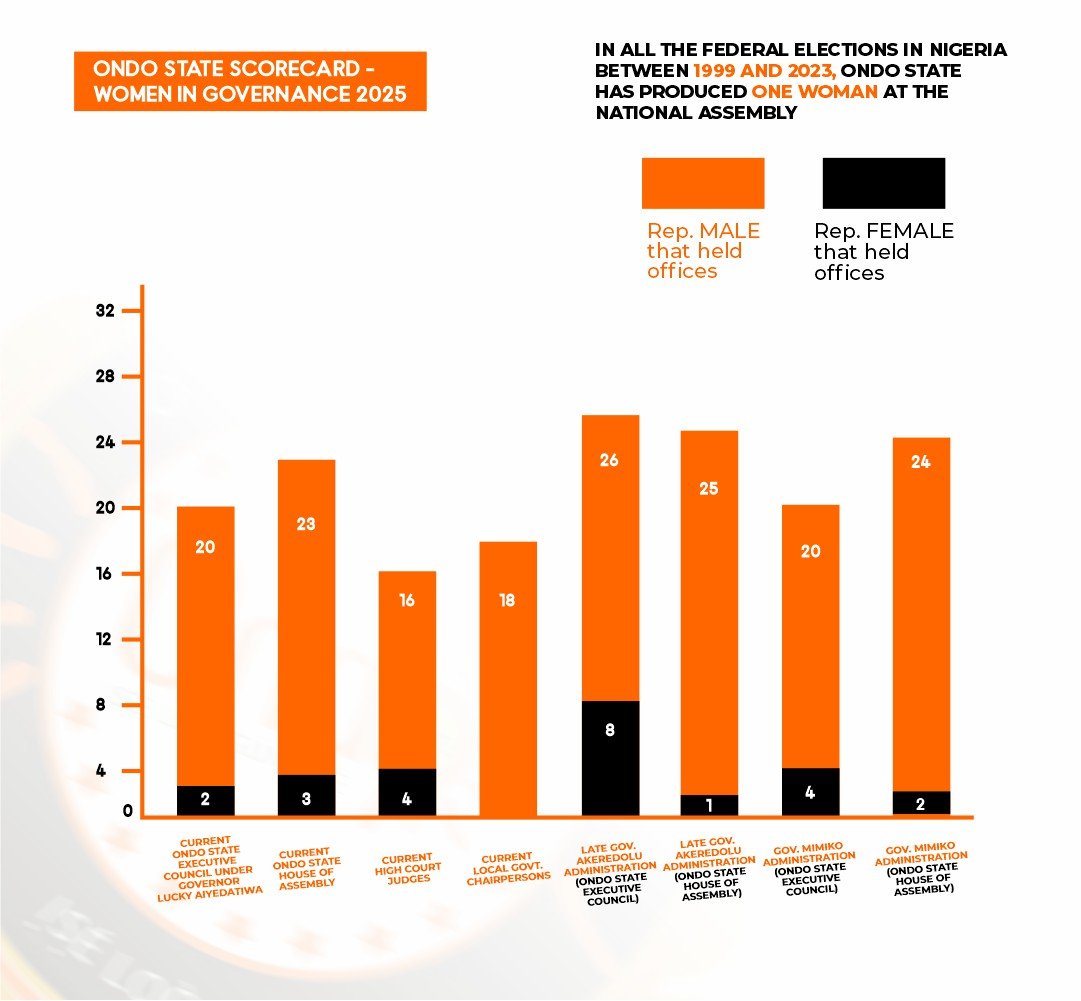
However, the administrations of Late Oluwarotimi Akeredolu and Dr. Olusegun Mimiko also had low women representation below the 35% affirmative action. The administration of the Late Governor Akeredolu had one woman at the state House of Assembly and 8 Women out of the 34 State Executive Council. Similarly, the former Governor Olusegun Mimiko administration had 2 women out of 26 members of the State Assembly; similarly, the State Executive Council had 4 women out of 20 members. (INFOGRAPHICS).
In the Federal general elections since 1999, Ondo State has produced one woman at the National Assembly. She is Hon. Janet Febisola Adeyemi, who represented Ile Oluji-Oke Igbo/Odigbo Constituency under the Alliance for Democracy, at the fourth Assembly.
Osun: When Half the Sky is Shut Out
If Ondo is a battlefield of broken dreams, Osun is a study in exclusion by design. The 2022 governorship election in the state offered little hope for women determined to break into political leadership. 15 political parties fielded candidates for the poll. Every single governorship candidate was a man. Out of those 15, only 6 picked women as deputy governorship candidates, a decision many observers dismissed as tokenistic.
“It is almost as if they are saying: ‘we know women exist, so let us add one as deputy to avoid embarrassment,’” said Mrs. Adebimpe Ajayi, a political analyst in Osogbo.“But when it comes to real power, the number one seat, they shut the door completely.”
Even in appointive positions, the story is grim. When Governor Ademola Adeleke announced his first cabinet list in 2023, only 4 of the 32 members of the Executive Council were women. That figure, about 23 percent, fell far short of the 35 percent affirmative action Nigeria pledged at the Beijing Conference in 1995. Also in 2025, the story is still the same, with the status of 23 percent of women in the Osun political cabinet.
At the State legislature, the 26-member House of Assembly is male-dominated, with a man who is unavoidably the Chairman of the House Committee on Women Affairs. The Judiciary also reflected low female representation, with the current High Court judges having 8 females and 14 males. This pattern of gender imbalance in political representation does not fare better at the National Assembly level. All the three 3 Senatorial Districts and 9 House of Representatives seats for Osun state are occupied by males following the 2023 election.
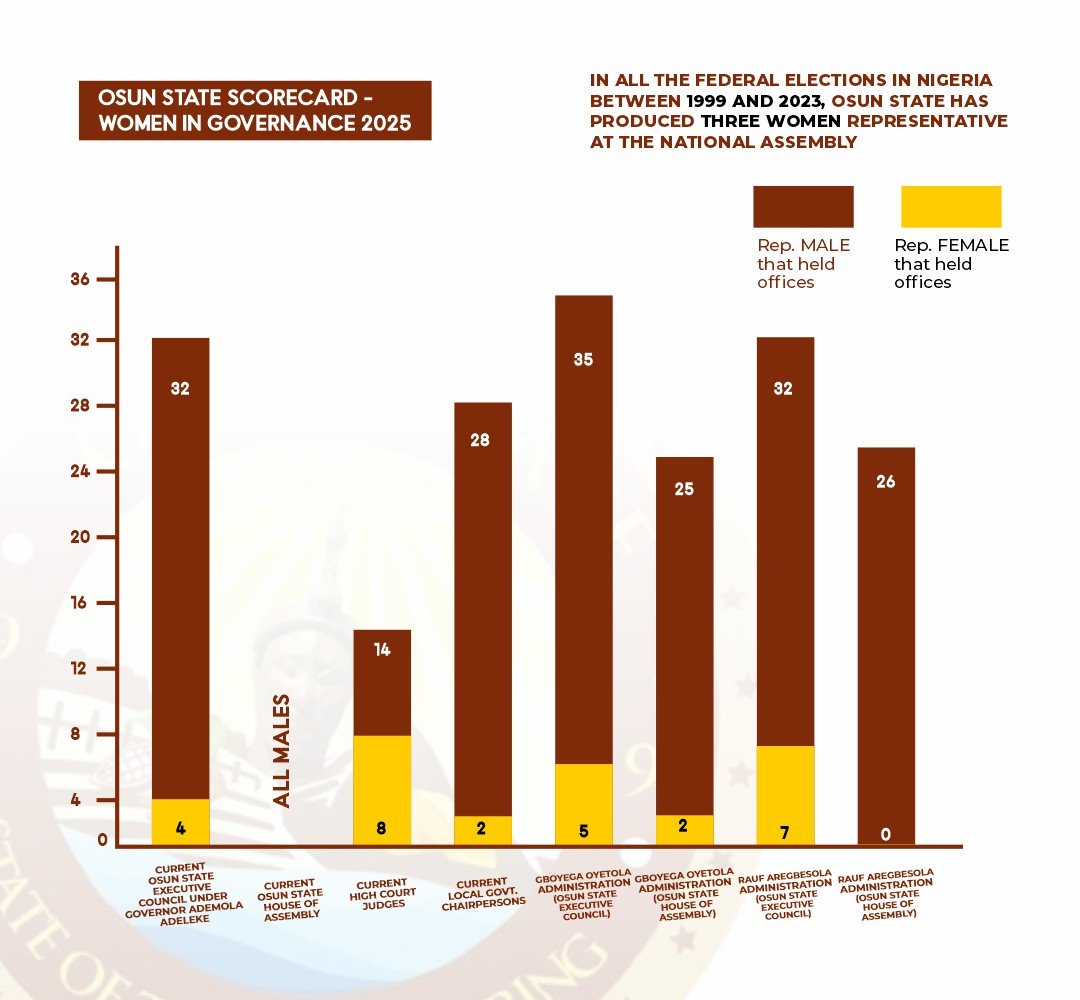
The trend is a bit worse at the local government level, where 28 males and 2 females emerged as leaders of the 30 local Governments during the February 2025 council election. Despite the agitation for increased balanced gender representation within the ruling People’s Democratic Party in Osun State, the story still remains the same.
“The gap is glaring,” said Hon. Taiwo Oluga, who represented Ayedaade/Irewole/Isokan Federal Constituency in the 9th House of Representatives.“Women form almost half of Osun’s voting population. We queue under the sun, we vote, we mobilise, but when it is time for appointments or for real decision-making, men take the lion’s share.”
In 2018, 45-year-old Accountant, Mrs Mercy Adeoye contested for the governorship seat under the Restoration party, which has been deregistered now by INEC, and she expressed disappointment on how there is no single woman from number one to five presently in Osun state political leadership.
“Most of the time, 80 percent of women who participated in politics lose out at the primary level. In the present government, women are nowhere. Senate, House of Representatives, House of Assembly women have been sidelined under this present administration, the previous administration of Governor Rauf Aregbesola and Gboyega Oyetola was not this gender bias”. Adeoye stated.
These trends reflected the gaps in gender disparity; even in the previous administration, it was almost the same, with very few women in leadership. The administration of former Governor Rauf Aregbesola had few women in the cabinet, with a woman being the deputy Governor of the state, Iyaafin Grace Titi Laoye-Tomori, and 7 other women at the cabinet level out of 39 members of the State Executive Council, but the House of Assembly had no women.
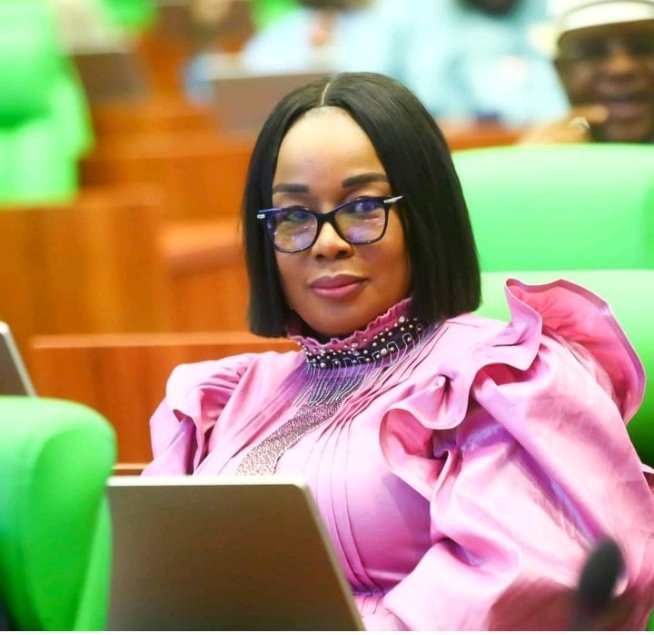
Similarly, the former Governor Gboyega Oyetola administration had 2 females at the House of Assembly and at the state cabinet had 5 women out of 35 members. Out of the 9 federal constituencies and 3 senatorial districts in Osun State, only Ayedaade/Irewole/Isokan Federal constituency had produced 3 female representatives in the history of the state, with the current representative consecutively at the lower chamber of the National Assembly between 1999 and 2023. They are: former speaker of the House of Representatives, Hon. Patricia Olubunmi Etteh, 1999-2011; Hon. Ayo Omidiran, 2011-2019; and Hon. Taiwo Oluga, 2019-2023, who is presently a Federal Commissioner at the National Assembly Service Commission in Abuja.” Therefore, across all three administrations at the state and federal levels since 2010, women representation has been below the 35% Beijing pledge Nigeria signed up to”.
Relating her story, Hon. Taiwo Oluga, from 2019-2023, affirmed that she was able to secure a ticket through the zoning to her local government by leaders of the party at the local to the state level. She contested alongside five males in the election. These cultural perceptions reinforce political structures that are already biased, she noted.
However, the race for another Osun election is scheduled for August. The 2026 Osun governorship race is already shaping up, with three male heavyweights, incumbent Governor Ademola Adeleke of the PDP, APC chieftains Alhaji Bola Oyebamiji, Prince Dotun Babayemi, and Senator Jide Omoworare, among others, in the field. Again, no female aspirant has declared interest or is ready to show interest, reinforcing a recurring question: Is political leadership in Nigeria structurally rigged against women?.
Parties as Gatekeepers
Across both Ondo and Osun, one fact is undeniable: political parties are the biggest gatekeepers in Nigeria’s democracy. And those gates are firmly controlled by men.
Party primaries are where battles are won or lost. But women often find themselves sidelined before the first ballot is cast. In Ondo’s APC, for example, Waheed-Adekojo alleged that the screening process was designed to eliminate women. “The guidelines looked neutral, but when you interpret them, you realise they favour men with godfathers and deep pockets,” she said.
In Osun, several female aspirants who initially expressed interest in contesting the governorship eventually dropped out, not because of a lack of ambition, but because the party leadership either discouraged them outright or failed to provide support.
“It is not just about money alone,” said Dr.Samaria Olarinde-Olomola, a Gender Development Expert at Elizade University, Ondo state. “It is about access. Men have the network. Women are often left begging for crumbs, and that reflects in the kind of positions they are offered: deputy, women’s leader, or adviser on welfare. Very rarely do you see a woman being positioned as the candidate of a major party.”
By contrast, according to a Foundation for Investigative Journalism report published in 2025, in Nigeria, women held fewer than 5 percent of elective positions after the 2023 elections. In Southwest Nigeria, Osun, Ekiti, and Ondo have slightly fair female representation compared to many Northern states. Still, none of these states meets even a 20 percent threshold for women in state assemblies, and cabinet positions remain male-dominated.
According to Dr. Olarinde-Olomola, “This underrepresentation has significant consequences. Research consistently demonstrates that women in leadership positions enhance budget allocations for health, education, child protection, and security, while also strengthening economic outcomes. Nigeria, especially its individual states, is missing out on these benefits by allowing the existing political system to marginalise women”.
Even within the parties, the so-called concessions for women, such as free or discounted nomination forms, are derided as half-measures. “How does free form help when you don’t have money for campaign buses, billboards, or mobilisation?” asked Mrs Anifowose rhetorically.
The Peoples Democratic Party, Director of Media and Publicity, Ondo State, Leye Igbabo, blamed the women for failing to take advantage of their numbers to have their way, rather than this cap-in-hand approach, which is making them appear to be fighting from a weak pedestal.
“This game is about numbers, and invariably, women have this. There are a lot of women organisations that are sensitising women to present themselves for elective posts; they should continue to do more advocacy. Presently, they claim to have gotten over 1000 signatures to push their position on the Reserved Seat for Women Bill. Can’t they use such a method to also galvanise support for themselves during elections? Unfortunately, whenever any woman goes for a contest, she doesn’t get the expected support, even from the women’s camps! You remembered the time, Mrs Sarah Jubril contested for the presidency about four times.” Mr Igbabo stated.
The Power of Culture and Religion
Politics in Nigeria does not exist in a vacuum. It is shaped by cultural norms and religious interpretations. Both factors play a heavy role in how women are perceived. In Ondo and Osun, many communities still frown at women who aspire for the top job.
During her campaigns, Mrs Jumoke Anifowose recalled hearing statements like, “How can a woman govern men?” or “Our culture does not allow women to lead men in public life.”
Such sentiments are reinforced from the pulpit and mosque. In some churches, pastors openly preach that women should submit to their husbands and not “compete” with men in leadership. In certain mosques, clerics interpret Islamic teachings to mean women must stay away from political ambition.
“These cultural and religious barriers are as strong as money barriers,” said Dr. Aina Oyekanmi, Chief Consultant of the Federal Neuro-Psychiatric Hospital, Abeokuta. “When women are told from childhood that leadership is not their role, by the time they become adults, even the bold ones face ridicule and rejection.”
The irony is that the same societies that resist women in politics gladly embrace them in markets, farms, and home spaces where their labour sustains the family and economy.
Civil Society and the Push for Change
Despite these challenges, civil society organisations are pushing back. Groups like the Justice Development and Peace Makers Centre, Kimpact Development Initiative, Women in Politics Forum, and several local NGOs in Ondo and Osun have consistently advocated for more female representation.
The Head, Programme for Democracy and Good Governance, Justice Development and Peace Makers Centre, Osun State, Mr. Festus Ojewumi, said campaign financing, political violence, and ideology are among the major challenges.
During the 2024 governorship election in Ondo State, Folasade Bamigboye served as state coordinator for a non-governmental organisation, Kimpact Development Initiative, KDI. She shared her experience on how women have difficulty ascending leadership positions due to limited resources interpreted as money bag politics that’s rampant in the Nigerian electoral system.
“In the last governorship election, some women were saying we have voted and collected money, this is one of the challenges, even women electorates prefer to align with male candidates that can give them money”.Bamigboye stated.
In 2023, a coalition of women groups in Osun launched the “Half the Sky” campaign, demanding that Governor Adeleke appoint at least 40 percent women into his cabinet. They argued that since women constitute nearly half the electorate, anything less was undemocratic.
“We are not asking for charity,” said the group’s leader, Mrs. Morenike Omowaiye. “We are asking for justice. Democracy is about representation, and if women are almost 50 percent of the voters, then they must be 50 percent of leadership.”
In Ondo, women organisations like the Nigerian Association of Women Journalists and other local NGOs rallied behind Waheed-Adekojo’s ambition, not because they believed she would necessarily win, but because they saw her candidacy as a test case for women’s political participation.
Mr Ojewumi noted at a recent political engagement in Osun ahead of the 2026 election that some political parties are not willing and ready to give their party ticket to women in the forthcoming election, suggesting that appointive positions seem easier to give women a voice rather than the elective positions.
The Global Contrast
The Global Gender Gap Index, released in 2025, ranked Nigeria 143rd out of 144 countries in women political representation, making Nigeria the lowest in five years. Similarly, data from the Inter-Parliamentary Union report states that Nigeria’s female political party representation ranked 148th out of 190 nations across the world. The index report further indicates that on a global average, women occupy 28.8 percent of top leadership positions, while the political empowerment gap stands at 22.9 percent.
However, the situation in Nigeria presents a different picture; 64 percent of the overall gender gap has closed, women hold only 6.6 percent of positions related to political empowerment, and just 3.4 percent of seats in the National Assembly.
The number from the global gender gap index shows that Nigeria is still facing significant challenges and opportunities in comparison, and the country can learn from regional success stories such as Sierra Leone’s comprehensive gender equality and Women Empowerment Act and Togo’s near gender equal legal framework. These can be seen in the stakeholders’ democracy policy vault for Africa.
Proffering a solution to disparities in gender representation
Dr. Omololá Olarinde-Olomola from Elizade University, Ilara-Mokin, Ondo state, stated that if Osun and Ondo are to align with global trends, they must move beyond token inclusion, adopting state-level gender quotas, reforming party candidate selection, and shifting social norms that treat politics as a male preserve.
Dr. Olarinde-Olomola suggested that Nigeria must intentionally legislate women into decision-making to help the country complete its democratic and economic vision as well as unlock the growth potential of its states.
Also, the Ondo coordinator of KDI, Folasade Bamigboye, suggested funding of a gender data initiative, which will help to promote gender parity as well as the intentional inclusion of women in political leadership to leverage women’s potential in politics.
“Nigeria’s gender inequality index score of 0.639 in 2021 still reflects the country’s significant gender disparities. Not having women in key decision-making positions has far-reaching effects on a country in terms of governance, education, equity, and development,” Bamigboye reaffirmed.
The Head, Programme for Democracy and Good Governance, Justice Development and Peace Makers Centre, Osun State, Mr. Festus Ojewumi, suggested that appointive positions seem easier to give women a voice rather than the elective positions due to huge campaign financing, political violence, and the ideology of most political parties, which are male-dominated.
“Every time we push for quotas, male lawmakers shout us down,” said Hon. Oluga.“They claim it will disrupt democracy. But the truth is,democracy without women is already disrupted.”
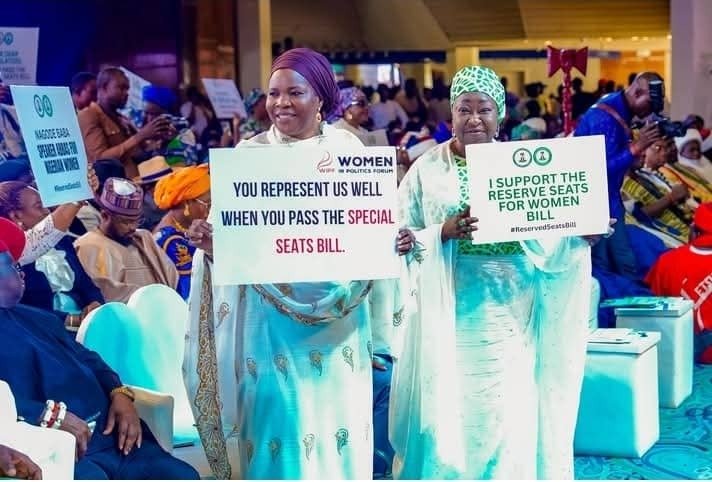
This brings to the fore the proposed “Reserved Seats for Women” bill, which is a constitutional amendment proposal aimed at increasing women representation in Nigeria’s National Assembly and State Assemblies. It’s proposing one additional seat for women per state and the FCT in both the Senate and House of Representatives, and three per state legislature, resulting in 74 new seats at the federal level and 108 seats across the state assemblies.
On the 22nd of September 2025, the House of Representatives had a public hearing to engage critical stakeholders and the sponsor of the bill, who is the Deputy Senate President, Hon.Benjamin Kalu, Women groups, civil society organisations. The bill has garnered support from the Nigerian President, Bola Tinubu, the Senate president, Goodwill Akpabio, and the United Nations Development Programme, UNDP, for Global Alignment. The bill aligns with international commitments such as the United Nations Sustainable Development Goals 5, focusing on Gender Equality.
In 2022, five “gender bills” were presented to the National Assembly, but they were all rejected, and this led to protests by various women groups. The bills are the Reserved Quota for Women in cabinet, Affirmative Action in Party Administration, Specific Seats for Women in the National Assembly, Indigeneship Rights for Married Women, and Granting Citizenship to Foreign-Born Spouses. The five gender bill did not get the needed votes to scale through. However, the “Reserved Seats for Women” bill may likely scale through this time, considering the support it is currently receiving from both the Legislative and Executive arms of government.
Speaking on the bill, a Professor of Political Science and Gender Development at the Adekunle Ajasin University, AAUA, Professor Bukola Adesuyi maintained that the bill is a good way to intentionally legislate women into political leadership in Nigeria, and to also rate Nigeria high in Global Gender Index, but also emphasised the need to adequately mentor women politicians by women leaders in the political space.
“For women to leverage their capacity in the political space, women-to-women support is required to scale through in politics. Women should serve as Godfathers to fellow women with adequate backing,” Prof Bukola Adesuyi added.
To encourage more women political participation at the grassroot in Ondo state, efforts are geared to mentor young women by political leaders through working out modalities, one of such is taken up by the present Commissioner for Women Affairs and Social Development, Dr. Seun Bosede Osamaye, who coordinated the women’s social political group termed O’datiwa women group, spread across the eighteen local governments with membership across board, particularly the All Progressive Congress, APC.
Another social political group is the Progressive Young Women’s Forum, Ondo State chapter, a political group founded in 2020 by the Executive Director of the Nexim Bank, Hon. Stella Okotete, promoting young women’s empowerment, political participation, and placement in leadership positions.
In his submission on addressing low women representation in leadership position,a governorship aspirant in Ondo state, Jumoke Anifowose suggested that women should come together appealing to Ondo State men to allow them to breathe and contest for elective positions saying there are no reasons why the women should not be given half of the membership of the Ondo State House of Assembly, particularly when state has two constituencies per local Government.
Speaking about the political party’s gender policy, the Peoples Democratic Party, Director of Media and Publicity, Ondo State, Leye Igbabo said that the PDP encourages women participation by giving them free forms to contest for any offices of their choice.
“The truth of the matter is that you cannot force someone who is not ready to come and collect forms by force. Women must first bring themselves out, and then the party encourages them through many other means.” Leye Igbabo, the PDP Spokesperson, Ondo State, said.
Speaking on the All Progressive Congress Party policy for gender inclusion, APC, Secretary in Ondo state, Mr Alex Kalejaiye, affirmed that to encourage more women to run for political office, the party had a fifty percent cut for women, and they are exempted from paying the Expression of Interest form.
“For appointive positions, the party has a thirty-five percent affirmative action, but most times the Governors are compelled to be more intentional in achieving that because there is no policy document to back it up, just a moral appeal, and in the real sense of it, some governors have gone beyond the appeal to have more women, while some have not.” Kalejaiye Alex, APC secretary, Ondo State.
The global comparison of women in leadership makes Nigeria’s case even more tragic. The acclaimed giant of Africa, a supposed leader on the continent, is one of the worst in including half its population in leadership.
Despite the bleak picture, some signs of hope are emerging. In local council elections in Osun, a few women have begun to win councillorship seats. In Ondo, young female activists are increasingly vocal in demanding representation. Social media has also given women a platform to challenge stereotypes. Waheed-Adekojo, for example, has a strong following online, where she shares her inspiring journey and encourages other women not to give up.
“I may not have won,” she said after the APC primaries, “but I have opened a door. Others will walk through it. And one day, a woman will sit in the governor’s office in Ondo State.” Waheed -Adekojo maintained.
This report was facilitated by the Wole Soyinka Centre for Investigative Journalism (WSCIJ) under the Champion Building component of its Report Women! News and Newsroom Engagement project.